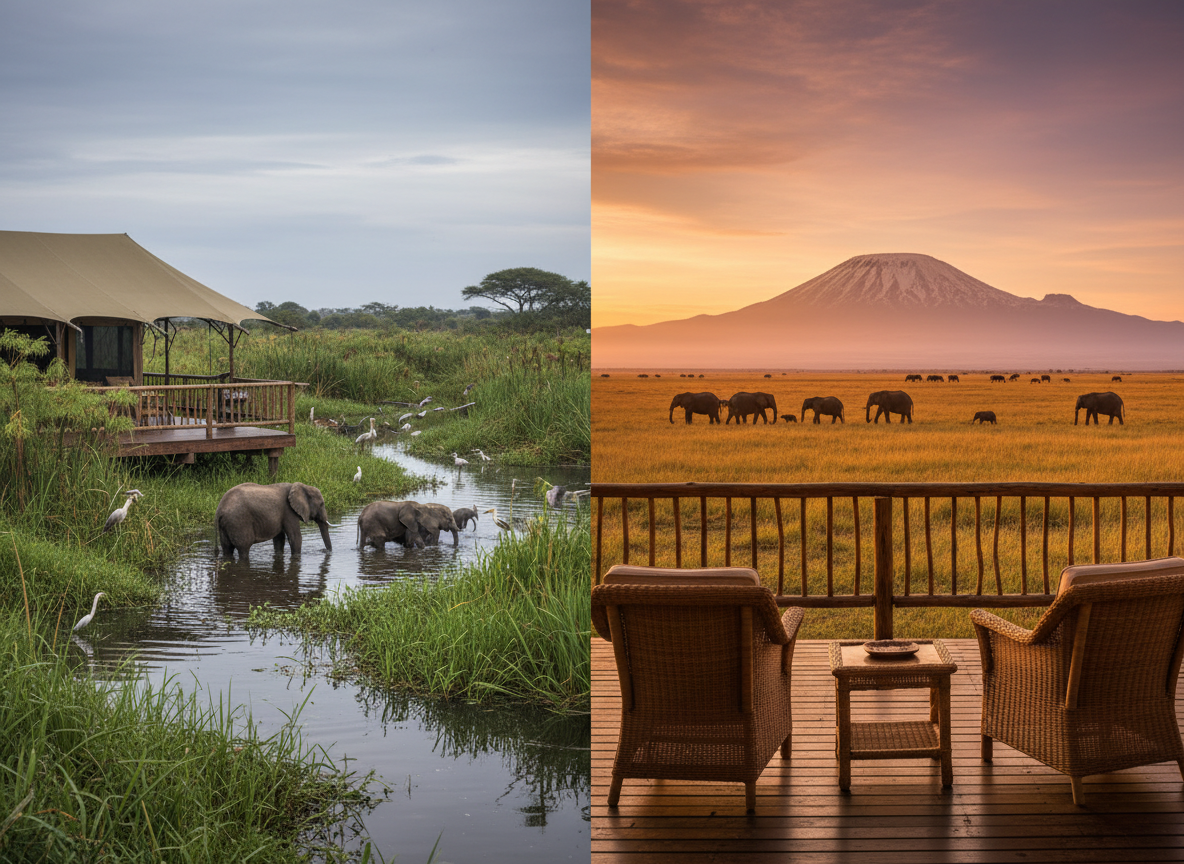
Amboseli National Park has two visual signatures that travellers come specifically to experience. One is the swamp — the permanent wetlands fed by Kilimanjaro’s underground snowmelt that draw the park’s famous elephant herds, hippo, and abundant birdlife to a single concentrated zone. The other is the mountain — Kilimanjaro rising to 5,895 metres above the flat Amboseli plain, its snow-capped peak visible on clear mornings above the acacia woodland.
Camps in Amboseli are positioned differently relative to each of these features. That positioning affects not just the view from your tent but the character of the experience — what wildlife you see from camp, what the morning light looks like, and what photograph you are most likely to come away with. The choice between a swamp-facing camp and a Kilimanjaro-facing camp is worth making deliberately.
What the Swamp View Delivers
Camps positioned on or near the Enkiama swamp and its associated wetland margins deliver a view that changes by the hour. The swamp is not a static background; it is an active ecosystem that wildlife moves through continuously.
Elephant herds enter and leave the swamp margins through the day in response to heat, feeding, and social dynamics. The herds that Amboseli is famous for — deeply studied, individually known, often with calves and juveniles that make family-watching particularly engaging — are concentrated here more than anywhere else in the park. From a swamp-side camp, it is possible to watch elephant movement from a tent or from the camp’s common areas without getting into a vehicle.
The birdlife along swamp margins is exceptional. African fish eagle are reliable residents. Sacred ibis wade the shallows. Herons, egrets, and kingfishers work the water’s edge. Hippo are audible and often visible from swamp-adjacent positions. The layered sound and movement of a wetland ecosystem is a specific sensory experience that an open-plains camp cannot replicate.
Swamp-facing camps often feel more immersed in the ecosystem. The view from breakfast is wildlife-active regardless of whether Kilimanjaro is visible, which means a cloudy day — common in Amboseli, where the mountain is frequently obscured by afternoon and morning cloud — does not diminish the sense of being somewhere remarkable.
What the Kilimanjaro View Delivers
A camp positioned with a clear sightline toward Kilimanjaro offers something different: the possibility of one of the most iconic photographic compositions in East Africa.
The standard Amboseli image — an elephant or elephant herd in the foreground, Kilimanjaro rising to its snowfields behind — is both genuinely spectacular and realistically achievable from the right camp position in the right conditions. That image has appeared in wildlife magazines, documentaries, and photography portfolios for decades for good reason. The juxtaposition of Africa’s most charismatic megafauna against Africa’s highest peak is visually powerful in a way that is hard to replicate anywhere else.
The challenge is that Kilimanjaro is not reliably visible. The mountain generates its own cloud cover most afternoons and is frequently hidden entirely by mid-morning. The clearest views tend to come at dawn before cloud builds — which aligns usefully with early morning game-drive timing — and on some evenings when the cloud clears. But travellers who specifically choose a Kilimanjaro-facing camp for the mountain view should understand that they may see it on two or three mornings of a four-night stay and not at all on the others.
Kilimanjaro-view camps are typically positioned on the open plains side of Amboseli, further from the concentrated wetland wildlife than swamp-side camps. The open plains are excellent for cheetah and for watching the large dust plumes that elephant herds raise on dry days, but they lack the constant wildlife activity of the swamp margin.
The Photography Consideration
For photographers, the choice has clearer implications.
Wildlife photographers who prioritise elephant family shots with natural wetland backgrounds, close elephant encounters, and consistent subject availability throughout the day will prefer swamp-side positioning. The light at the swamp in the early morning, when elephants are active at the water’s edge, is excellent for natural-light photography.
Landscape and wildlife photographers whose primary goal is the Amboseli icon shot — elephants against Kilimanjaro — need the mountain-facing camp position. But they should also plan to do early morning drives specifically oriented toward the mountain view and accept that the shot requires both a clear dawn and wildlife in the right foreground position simultaneously.
Neither scenario is guaranteed. Both require good guide knowledge of where specific animals are and where the light will work.
Reading Amboseli’s Camp Landscape
Several of Amboseli’s most established camps sit near or adjacent to the Enkiama swamp. Amboseli Serena Safari Lodge, Ol Tukai Lodge, and Amboseli Sopa Lodge are among the properties with proximity to the swamp or views across it, though specific camp positions within the park vary.
Camps on the park’s more open southwestern and northwestern edges tend to have better Kilimanjaro orientations on clear mornings. Specific confirmation of view orientation should be sought directly from the camp at booking, since marketing materials do not always make the exact position clear.
Some camps can offer both: a swamp-side position with an open westward horizon that includes Kilimanjaro when visible. In these cases the camp gets the best of both orientations, though usually with one being more pronounced than the other.
Making the Decision
The clearest framework for choosing: if wildlife immersion and consistency of wildlife at camp is your primary value, choose a swamp-facing position. If the Amboseli icon image with Kilimanjaro is a fixed photography objective, choose a mountain-facing position and accept that you will need clear weather to get it.
For first-time Amboseli visitors without specific photography objectives, swamp proximity typically delivers the more reliable and more active experience. The mountain is a bonus; the elephants at the swamp are the reason Amboseli exists as a safari destination.
For return visitors who have already experienced the swamp-side camps, a different camp position — whether mountain-facing or on one of Amboseli’s open plains edges — adds a different perspective on the same ecosystem that can make a second visit feel distinct from the first.
Both positions have their honest appeal. Neither is objectively better. The difference is in what you want to prioritise during the hours you are actually at camp rather than in a game drive vehicle.
Prefer a different route, budget, or travel style? This plan can be adapted to fit.
Customise Your Trip